I recently finished this book Von Braun: Dreamer of Space, Engineer of War by Michael Neufeld.
This post is a reprint of my book review on Amazon.com
Debbie Downer History of Von Braun
This deeply detailed biography seems to say that von Braun's popular image was more about fame and personality than real accomplishments or importance in the history of the Space program and even before. Not having studied the man before, I have to admit to buying in the general mythology of his too until reading this. From an American perspective, there is something very positive about his life, he is the ultimate immigrant success story, a case of American pragmatism to accept a national of a former enemy and promote him to the very heights of power in our government, that opportunism (on both sides) is very Stangelove-ian and in strange way admirable to me. He was apparently a likeable and charismatic man with big dreams when the country was thinking big, so its not hard to see his rise to fame and power. The book, though, takes a hard look at his active cooperation with or at best neutrality towards the highest levels of the Nazi regime and the crimes of war in the production of the V2. Further complicating is the probable deceitfulness he expressed in later denying much of the story of his true involvement and an apparent lack of personal guilt. I am sure if I agree with the author that this criticism is deserved, but it is quite surprising to find out he was an SS officer.
I found that overall it seemed like the author was a little lopsided in the flow of the narrative, usually moving between personal/political challenges then various technical issues without any real success. It almost seemed like he never actually got any rockets or missles to actually work. Usually by the time the technical issues are sorted, the discussion moves to some other crisis, or the next project, with rarely discussing the actual successes. For instance, based on the way the book describes it, it didn't seem like they actually had any completely successful tests of the A4/V-2 before it was put into production and active duty, yet didn't thousands not in fact hit London and Antwerp (very little about the actual V2 bombings was mentioned)? After the war it seemed as of Von Braun and the rest of the paperclip scientists spent 5-6 years doing little of anything in Texas, later Huntsville, AL, which if totally accurate is amazing considering how much attention that group of scientists was given supposedly. His group's contributions to the overall American rocket and missile field appear modest, without much impact on the Cold War. Whole chapters deal with the US Army's efforts to develop ballistic missiles, such as Redstone and Jupiter-C, were either ever used for anything in practice? The book basically portrays these efforts as one development issue or lack of mission crisis after the other with little mention of any actual outcome from these efforts. Its hard to miss the success of the Saturn V and von Braun's central role in that effort, due to the Apollo moon landings, though great pains are taken to portray him as as subordinate center director in NASA rather than a leading figure. In the end his tenure at NASA headquarters is described as a depressing frustration and his post-NASA career also at Fairchild is also portrayed with mix results.
Maybe the author was purposefully trying to contradict some other more glowing histories of the man, though I suspect the truth is somewhere in between. A lot of the details of his personal and professional life still do impress, even if he didn't really do anything successfully, he seemed to work pretty hard for his entire career.
The more I read about the subjects of NASA (To the Ends of the Solar System, Moon Hunters), the more of a happy coincidence we had to even get to the moon (Kennedy's promise, followed by a pro-space successor in Johnson). It is quite eye opening to read these behind the scenes accounts of the political and budgetary battles in government that ended up killing any really expansive manned space program after Apollo that we've all read about. Its amazing how the government made it seem like we were on this mission to the next big thing it just needed more time, when in reality they were consciously killing programs that would get us to Mars or put stations in space.
I read the book in paperback edition. One improvement is that it could have used some maps of Europe and Germany, especially for the Peenemünde era and World War II. As an aside his name is pronounced in German: "Vairner fon Brown"
Saturday, June 23, 2012

Saturday, June 16, 2012
Too Basic
As a follow up to my last post on our struggling redwoods. I've performed some tests of the soil pH
From a a local garden supply store I bought a pH testing kit with 10 uses. Its pretty simple to use. Just put some soil into the test container, add a special capsule of grey powder and mix with water. I took a sample from B2, shown here before mixing.
.jpg)
Here is the result after about a minute of settling. The color didn't come through great, but it was a fairly dark green, looking to be around pH 7.0 - 7.5, which is too alkaline according to the info I have above.
 According to the kit anyway, there isn't much you can do to change a soil that is alkaline to more acidic, though they do mention some: aluminum sulfate or iron sulfate as ways to lower pH.
Will any of this work for B2?

So somewhat ruling out the pot size for now, the temperature and weather didn't really seem to be a factor. We had a really mild winter this year, almost no snow, and not too cold. Again both redwoods have been indoors, and sitting by some windows, so they probably never get much colder than around 60 degrees or so. The only other thing I haven't really checked, is the pH level of the soil, I read somewhere that they need a slightly acidic soil (pH 5.5 - 6.0).
From a a local garden supply store I bought a pH testing kit with 10 uses. Its pretty simple to use. Just put some soil into the test container, add a special capsule of grey powder and mix with water. I took a sample from B2, shown here before mixing.
.jpg)
Here is the result after about a minute of settling. The color didn't come through great, but it was a fairly dark green, looking to be around pH 7.0 - 7.5, which is too alkaline according to the info I have above.

Will any of this work for B2?

Friday, May 11, 2012
Redwoods Struggling On
One of my hobbies for the past few years has been raising a pair of Coastal Redwood seedlings indoors, far outside their normal range and documenting the results. I have been a little lax about posting updates although its been a pretty dramatic winter.
After a lot of growth last spring and summer redwoods seemed to be doing pretty well, branching out, growing new shoots, of the two, J2 seemed to be healthier with more mid-level branches and about 20-21" in height, B2 while nearly the same overall height ( <19" ) at the top was much more spindly and only had a few offshoots. However things have been looking pretty bleak for the past several months. Here is how they are today.
This past winter season has not been kind to my redwoods, both experienced extensive browning or "burning" of their needles and then outer branches. The causes of this are mysterious to me. (If anyone has any experience with Redwoods indoors, I'd be happy to hear any suggestions).
This seems to be related to the season, although its not totally clear. The growth was definitely slow last winter, and I recall some browning of B2 especially. The pattern was much worse this year. I had a few guesses, maybe not enough water or moisture in general, although I do feel that we were pretty consistent all year long and the few times I tried adding a lot more water it didn't seem to have much effect.
We also have moved as you might see from the latest pictures. I thought that it might be level the sunlight that was part of the problem. That is my best guess right now, as since it's been warm enough to put them in the 3 season sun room (pictured), they've started a few shoots of regrowth. Earlier in the winter there was an accident that knocked J2 and cracked it's original pot. We re-potted into a new 8" diameter pot, that is fairly deep. Initially J2 did pretty well in the new pot at the new house. At the same time B2 started getting worse and more dry and brown, so since all other things were apparently the same we thought of re-potting B2 as well. So a few weeks later we also took B2 out of its original pot into the new 9" shown above. It was interesting and I should have photographed it, B2's root ball had one long root wrapped all the way around the base of the root ball, I wouldn't say it was root bound, but I can't say if that was a problem.
Initially there were some new shoots from B2 after the re-potting, but sadly the new shoots and needles withered and eventually died.
So somewhat ruling out the pot size for now, the temperature and weather didn't really seem to be a factor. We had a really mild winter this year, almost no snow, and not too cold. Again both redwoods have been indoors, and sitting by some windows, so they probably never get much colder than around 60 degrees or so. The only other thing I haven't really checked, is the pH level of the soil, I read somewhere that they need a slightly acidic soil (pH 5.5 - 6.0).
That comes back to the sun, it seems they are doing better with more direct sunlight, so we'll give that a try to see if they can recover.
Some final pics:
After a lot of growth last spring and summer redwoods seemed to be doing pretty well, branching out, growing new shoots, of the two, J2 seemed to be healthier with more mid-level branches and about 20-21" in height, B2 while nearly the same overall height ( <19" ) at the top was much more spindly and only had a few offshoots. However things have been looking pretty bleak for the past several months. Here is how they are today.
|
|


This seems to be related to the season, although its not totally clear. The growth was definitely slow last winter, and I recall some browning of B2 especially. The pattern was much worse this year. I had a few guesses, maybe not enough water or moisture in general, although I do feel that we were pretty consistent all year long and the few times I tried adding a lot more water it didn't seem to have much effect.
We also have moved as you might see from the latest pictures. I thought that it might be level the sunlight that was part of the problem. That is my best guess right now, as since it's been warm enough to put them in the 3 season sun room (pictured), they've started a few shoots of regrowth. Earlier in the winter there was an accident that knocked J2 and cracked it's original pot. We re-potted into a new 8" diameter pot, that is fairly deep. Initially J2 did pretty well in the new pot at the new house. At the same time B2 started getting worse and more dry and brown, so since all other things were apparently the same we thought of re-potting B2 as well. So a few weeks later we also took B2 out of its original pot into the new 9" shown above. It was interesting and I should have photographed it, B2's root ball had one long root wrapped all the way around the base of the root ball, I wouldn't say it was root bound, but I can't say if that was a problem.
Initially there were some new shoots from B2 after the re-potting, but sadly the new shoots and needles withered and eventually died.
So somewhat ruling out the pot size for now, the temperature and weather didn't really seem to be a factor. We had a really mild winter this year, almost no snow, and not too cold. Again both redwoods have been indoors, and sitting by some windows, so they probably never get much colder than around 60 degrees or so. The only other thing I haven't really checked, is the pH level of the soil, I read somewhere that they need a slightly acidic soil (pH 5.5 - 6.0).
That comes back to the sun, it seems they are doing better with more direct sunlight, so we'll give that a try to see if they can recover.
Some final pics:
 |
| J2 |
 |
| B2 top |
Saturday, March 10, 2012
The second India Trip

Map of Karnataka province

On a totally unrelated note. Check out this cool demonstration of a parallax effects using jquery and 3 image layers (back, middle, front)
Tuesday, February 14, 2012
Review of code.nasa.gov
I was reading an article on Google News, that NASA Powered Down Final IBM Z9 Mainframe, in favor of moving to more server (Linux) based applications. Its a smart move, given the recently announced looming budget cuts. But what caught my eye in that story was a reference to NASA deciding to put all it's Open Source projects under one banner, "code.nasa.gov".
Having participated in one of these projects, World Wind.NET, I was curious to see the state of that project as I've not worked on World Wind for some time now. From what I recall, all projects that were under the NOSA [NASA Open Source Agreement] license, were in fact all listed in one site, back when I contributed to the World Wind project, it escapes my reaches at the moment, but it was a very dated, plain site with many projects I've ever heard of.
In any case, code.NASA.gov is the cool Web 2.0 portal to a variety of projects, it has search and basically that is it. What I found by searching for "World Wind" was a single project page referring only to the World Wind JAVA project: http://code.nasa.gov/project/world-wind-java/. There is not a lot of information there, just a one sentence description, and a link to an externally hosted source code repository on GitHub. I don't see anything about the main developers focused on the WWJ project (from what I recall), I don't see links to WorldWindCentral, the site that hosts the main, active public Forum or the Wiki.
To my disappointment there was also no mention, no link to the source for the WorldWind .NET project which has it's own C# codebase separate from the Java project. I guess you can't expect too much, but to me the fact that they publicize this site as some kind of accomplishment is a little pointless, its a search engine for all NASA Open Source projects, its not a community or anything more. What might be slightly more useful is the related, sites, http://open.nasa.gov/ which has a blog, and I suppose http://data.nasa.gov, which links to other sites containing NASA provided data, which I believe is all in the public domain.
Out of curiosity, I went and revisited the WorldWindCentral forums, not only has NASA stopped supporting or contributing to the WorldWind .NET project, they've apparently turned off all the imagery servers serving the tiles in the format that .NET client application could receive. One of the forum members under his own initiative worked on methods to download the WWJ format data to feed in to the .NET client. This was one of the reasons I gave up participating in that project, it felt like a dead end. Even more shockingly, the developers for WorldWind Java have been asking for donations to keep the WorldWindCentral forums running, this is for a currently active project.
Having participated in one of these projects, World Wind.NET, I was curious to see the state of that project as I've not worked on World Wind for some time now. From what I recall, all projects that were under the NOSA [NASA Open Source Agreement] license, were in fact all listed in one site, back when I contributed to the World Wind project, it escapes my reaches at the moment, but it was a very dated, plain site with many projects I've ever heard of.
In any case, code.NASA.gov is the cool Web 2.0 portal to a variety of projects, it has search and basically that is it. What I found by searching for "World Wind" was a single project page referring only to the World Wind JAVA project: http://code.nasa.gov/project/world-wind-java/. There is not a lot of information there, just a one sentence description, and a link to an externally hosted source code repository on GitHub. I don't see anything about the main developers focused on the WWJ project (from what I recall), I don't see links to WorldWindCentral, the site that hosts the main, active public Forum or the Wiki.
To my disappointment there was also no mention, no link to the source for the WorldWind .NET project which has it's own C# codebase separate from the Java project. I guess you can't expect too much, but to me the fact that they publicize this site as some kind of accomplishment is a little pointless, its a search engine for all NASA Open Source projects, its not a community or anything more. What might be slightly more useful is the related, sites, http://open.nasa.gov/ which has a blog, and I suppose http://data.nasa.gov, which links to other sites containing NASA provided data, which I believe is all in the public domain.
Out of curiosity, I went and revisited the WorldWindCentral forums, not only has NASA stopped supporting or contributing to the WorldWind .NET project, they've apparently turned off all the imagery servers serving the tiles in the format that .NET client application could receive. One of the forum members under his own initiative worked on methods to download the WWJ format data to feed in to the .NET client. This was one of the reasons I gave up participating in that project, it felt like a dead end. Even more shockingly, the developers for WorldWind Java have been asking for donations to keep the WorldWindCentral forums running, this is for a currently active project.
Saturday, January 28, 2012
In Support of Gingrich's Moonbase

"By the end of my second term [2020], we will have the first permanent base on the moon and it will be American,"This has actually become a major political story, with Newt's poll numbers dropping in Florida and it becoming a debate talking point of his rivals.
I am no Newt supporter, I supported Obama in 2008 and will absolutely vote for him over any Republican in the field this time. But while it makes me cringe to say it, nothing he is saying is unreasonable, and furthermore the criticism he is getting for this one-liner reflects more on the current state of America than on Newt Gingrich's supposed erratic behavior. A sound bite from Romney during a debate has been repeated several times today:
"I spent 25 years in business, If I had a business executive come to me and say they wanted to spend a few hundred billion dollars to put a colony on the moon, I'd say, 'You're fired.'"[1]

Not to get all science-fiction-y, but the idea of the Moon-base is hardly new, or outlandish either. Since the 1950s, Arthur C. Clarke and others(including governments) have made proposals for lunar colonization. There has been plenty of NASA and independent research on the idea of space colonization generally from the 1970s. Yes, there is plenty of debate even among space enthusiasts over the best strategy of exploration and colonization, from orbital space stations, direct to Mars missions or other ventures to asteroids, a gradual approach to all of the above etc. Not to discount any other approach (in fact, my preference would be some kind of space colony at a Langrangian point such as Earth-Moon L4/L5), but even if you search right now on NASA's website they have a whole Why the moon? page with documents from as recent as 2006 with various suggested motivations for going back to the moon, including eventually extending human civilization with permanent settlements. Among 6 reasons selected for going back to the moon (in the exploration sense, initially at least:
Human CivilizationSign me up! I don't think I am alone either in my view that the Gingrich's idea itself isn't outside what is possible given our current technology, nor a worthless exercise. The timeline might be aggressive, with current NASA resources, although, the Constellation program under President George W. Bush sounds remarkably like what Gingrich is talking about, in a way, they are saying the same thing as President H.W. Bush did in 1989, when he proposed a return to nuclear rocket research[4] aimed at goals of a moon base and Mars missions. [5]
Extend human presence to the moon to enable eventual settlement.
Scientific Knowledge
Pursue scientific activities that address fundamental questions about the history of Earth, the solar system and the universe - and about our place in them.
Exploration Preparation
Test technologies, systems, flight operations and exploration techniques to reduce the risks and increase the productivity of future missions to Mars and beyond.
Global Partnerships
Provide a challenging, shared and peaceful activity that unites nations in pursuit of common objectives.
Economic Expansion
Expand Earth's economic sphere, and conduct lunar activities with benefits to life on the home planet.
Public Engagement
Use a vibrant space exploration program to engage the public, encourage students and help develop the high-tech workforce that will be required to address the challenges of tomorrow.
I could write a whole other article on the feasibility of nuclear rockets, after just finishing a book on the subject, The Nuclear Rocket: Making Our Planet Green, Peaceful and Prosperous, by James Dewar which delves into why chemical rockets will never truly allow for a equitable, private-sector based exploration or colonization beyond Earth orbit. In the case of the moon, we probably don't need to go there, though it adds interesting ideas to bring the cost down. That could be part of Gingrich's plan, but probably it isn't. In any case, its not even something his critics are really talking about.
This goes to my final point, obviously Gingrich has plenty of enemies now, from his current Republican rivals, to left-liberals still bitter over the 1994 Coup d'état, so as it is in politics, you don't really need a rational basis for attacking someone's ideas, it just needs to sound bad when taken out of context. But I find it odd, that even among the supposedly "patriotic" right-wing, who claims to believe so strongly in the notion of American exceptionalism, there is so little faith that such an idea, to build some kind of station on the moon in 8 years is an impossible dream? I wonder if this is the continuing creep of anti-science thought that is growing in this country, from evolution, stem-cells, climate change/global warming. This may just be the latest example where science and technological progress is denounced with no basis. Amazing that something that was done 50 years ago is now a crazy idea today!
I leave you with Niel deGrasse Tyson, making excellent points, explaining why we are declining and that we are losing our edge in space since we don't spend too much on space anyways...
References
[1] Oliphant, James, Robin Abcarian, Kim Geiger, and Michael Memoli. "Moon base! Freddie! Self-deportation! The GOP debate's top 5 moments." Los Angeles Times 27 Jan 2012, n. pag. Web. 27 Jan. 2012. <http://www.latimes.com/news/politics/la-pn-florida-debate-top-5-feistiest-moment-20120127,0,7763027.story?page=1>.
[2] O'Brien, Frank. The Apollo Guidance Computer. New York: Springer, 2010. Print.
[3] "Facts and Figures." International Space Station. NASA, n.d. Web. 27 Jan 2012. <http://www.nasa.gov/mission_pages/station/main/onthestation/facts_and_figures.html>.
[4] Bush, George H.W. NSPD-6. “Space Exploration Initiative.” NASA Historical Reference
Collection. (File: 012605). 9 Mar. 1992. <http://www.marshall.org/pdf/materials/867.pdf>
[5] Hsu, Jeremey. "All Spaced Out: Past President's Cosmic Visions." Space.com. N.p., 16 Apr 2012. Web. 27 Jan 2012. <http://www.space.com/8234-spaced-presidents-cosmic-visions.html>.
Images credit to NASA/courtesy of nasaimages.org.
Saturday, December 3, 2011
PunchClock 0.2.5 Released, JFace lessons
I finally got to a point where I thought enough of the nagging items with PunchClock were resolved that I would take the time to publish a new release. I am pretty proud of this release. There are no major new features but a lot of work went into making the code better, improving the infrastructure to make it a more rounded, solid product. For details on what was done, see the PunchClock 0.2.5 release announcement.
I've been personally using PunchClock versions daily to keep track of time at my work, I think I've pretty much gotten it to a stable, usable point. I don't see much new work going into it, unless I have some inspiration.
A couple of interesting lessons learned I think I'll share.
Utilizing JFace's built in ImageRegistry
I needed to add a custom error message to my Edit Session dialog. I did this using two labels. One that displays an icon (info, warning, error) and the other will have the message text. I tried using Label.setImage() for the label with the message text, however, the image "takes over" and no text is displayed, so I needed to keep them separate.
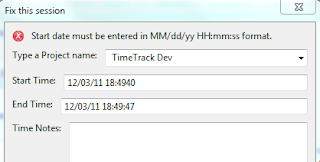
I know JFace must have the icons somewhere as they are used by the WizardPage status messages. It turns out they are available in the org.eclipse.jface.resource.JFaceResources.getImage() utility method. The icon images are available as constants of the org.eclipse.jface.dialogs.Dialog class.
Here is the setMessage() method from my custom EditSessionDialog class, it is called by a Listener that is attached to all the widgets in the form, listening on any change.
JFace ErrorDialog
As I transitioned all of the code in PunchClock away from writing out direct to the console, and instead used java.util.logging API, it became apparent that the way that exceptions were being handled was inconsistent, and in fact exceptions were getting thrown that were never handled. It seems that if there is no ExceptionHandler defined for the Window class, the exceptions don't get shown in the UI, though the program continues to run, leading to some unexpected results, such as clicking on a button and nothing seeming to happen.
So first step was to create a class that implements IExceptionHandler and then set it as the ExceptionHandler for my main window, using Window.setExceptionHandler(). This lets me catch all Throwables thrown and not caught in the PunchClock code.
Then I did find that JFace conveniently has a prebuilt dialog for displaying errors to the UI, which before I was able to do in one off cases using a custom built SWT dialog function. The example I took my queue from was here http://www.java2s.com/Code/Java/SWT-JFace-Eclipse/JFacesErrorDialogclass.htm
My example handleException method in my ExceptionHandler
It wasn't too clear what all these parameters do in terms of where they get used in the ErrorDialog. Here is an example of the error dialog produced by above code with a NullPointerException
 The title of the dialog, and the first message line is from the openError() method, second and third parameters respectively, the fourth parameter, the Status object, controls the "Reason:" message, and if you include the actual Throwable in the status it gets displayed in the expandable Details box, although that is not required, you can just pass null.
Editor's note: stay tuned for updates to the punchclock wiki and FAQ pages as I round out documentation with all the updates from the latest releases.
I've been personally using PunchClock versions daily to keep track of time at my work, I think I've pretty much gotten it to a stable, usable point. I don't see much new work going into it, unless I have some inspiration.
A couple of interesting lessons learned I think I'll share.
Utilizing JFace's built in ImageRegistry
I needed to add a custom error message to my Edit Session dialog. I did this using two labels. One that displays an icon (info, warning, error) and the other will have the message text. I tried using Label.setImage() for the label with the message text, however, the image "takes over" and no text is displayed, so I needed to keep them separate.
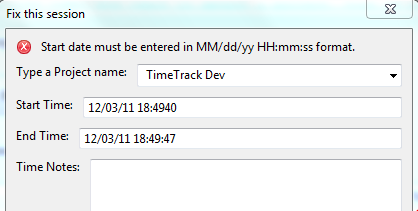
I know JFace must have the icons somewhere as they are used by the WizardPage status messages. It turns out they are available in the org.eclipse.jface.resource.JFaceResources.getImage() utility method. The icon images are available as constants of the org.eclipse.jface.dialogs.Dialog class.
Here is the setMessage() method from my custom EditSessionDialog class, it is called by a Listener that is attached to all the widgets in the form, listening on any change.
    /**
     * Updates the status message of this dialog with errors or other
     * information to display to the user.
     *
     * @param messageText
     *            - text to display
     * @param status
     *            - one of IMessageProvider constants
     */
    public void setMessage(String messageText, int status) {
        _logger.fine(messageText + ", status: " + status);
        Image messageImage = null;
        // based on status, display appropriate icon
        switch (status) {
        case IMessageProvider.INFORMATION:
            messageImage = JFaceResources.getImage(Dialog.DLG_IMG_MESSAGE_INFO);
            break;
        case IMessageProvider.WARNING:
            messageImage = JFaceResources
                    .getImage(Dialog.DLG_IMG_MESSAGE_WARNING);
            break;
        case IMessageProvider.ERROR:
            messageImage = JFaceResources
                    .getImage(Dialog.DLG_IMG_MESSAGE_ERROR);
            break;
        case IMessageProvider.NONE:
        default:
            messageImage = null;
            break;

        }
        // update the labels with new values
        _messageLabel.setText(messageText);
        _messageIcon.setImage(messageImage);
        _messageIcon.redraw();
        // resize widgets in dialog
        _messageIcon.pack(true);
        _messageLabel.pack(true);
    }
JFace ErrorDialog
As I transitioned all of the code in PunchClock away from writing out direct to the console, and instead used java.util.logging API, it became apparent that the way that exceptions were being handled was inconsistent, and in fact exceptions were getting thrown that were never handled. It seems that if there is no ExceptionHandler defined for the Window class, the exceptions don't get shown in the UI, though the program continues to run, leading to some unexpected results, such as clicking on a button and nothing seeming to happen.
So first step was to create a class that implements IExceptionHandler and then set it as the ExceptionHandler for my main window, using Window.setExceptionHandler(). This lets me catch all Throwables thrown and not caught in the PunchClock code.
Then I did find that JFace conveniently has a prebuilt dialog for displaying errors to the UI, which before I was able to do in one off cases using a custom built SWT dialog function. The example I took my queue from was here http://www.java2s.com/Code/Java/SWT-JFace-Eclipse/JFacesErrorDialogclass.htm
My example handleException method in my ExceptionHandler
/* (non-Javadoc)
     * @see org.eclipse.jface.window.Window.IExceptionHandler#handleException(java.lang.Throwable)
     */
    @Override
    public void handleException(Throwable arg0) {
        _logger.log(Level.SEVERE, "Uncaught exception from UI", arg0);
        // Create the required Status object
        Status status = new Status(IStatus.ERROR, "PunchClock", 0,
            "Unhandled Exception "+arg0.getMessage(), arg0);

        // Display the dialog
        ErrorDialog.openError(Display.getCurrent().getActiveShell(),
            "Error Occured", "Program Error. See PunchClock.log for more details.", status);
    }
It wasn't too clear what all these parameters do in terms of where they get used in the ErrorDialog. Here is an example of the error dialog produced by above code with a NullPointerException

Editor's note: stay tuned for updates to the punchclock wiki and FAQ pages as I round out documentation with all the updates from the latest releases.
Subscribe to:
Posts (Atom)